Choose Your Workflow, Then Your Gear
Most people buy the thing first and figure out what to do with it second. It's a natural impulse — the gear is the exciting, tangible part, and a new controller feels like progress you can hold. But it's backward, and it's why so many setups end up being a pile of features nobody actually uses.
The better question isn't "what should I buy?" It's "what do I want to be able to do?" Do you want to launch clips on the fly and improvise? Glitch loops up? Bend the tempo around? Play drum patterns with your fingers? Answer that first, in real terms, and the gear question mostly answers itself. You stop shopping for capabilities and start shopping for the specific controls that let you do the specific thing you already know you want to do.
I've changed my live rig more times in the last twenty years than I can count, and the one habit that's held up through it all is starting with the controls, not the box. Figure out what your hands need to do, then work outward to the hardware that puts those controls under them.
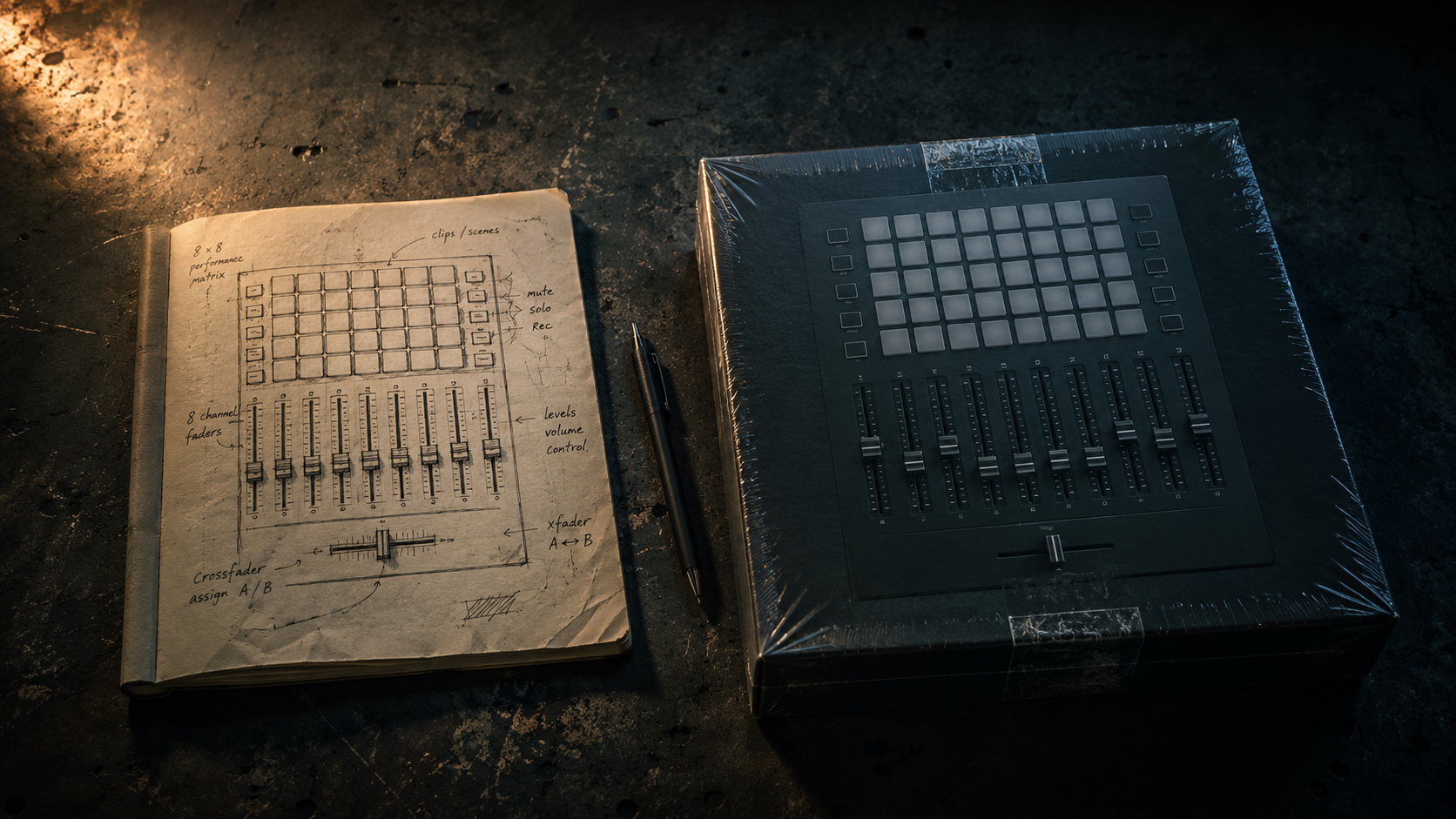
Here's how that actually plays out. At one point, I ran an Ableton Live set across eight channels — four for one "deck," four for the other, with drums, leads, bass, and everything else grouped into those four. Before I looked at a single piece of equipment, I worked out what I'd need to do to improvise well with that layout. I had to be able to fire clips from any channel, which meant buttons arranged in a grid. I had to ride each channel's level independently, which meant eight faders. And I had to crossfade between the two decks, which meant a crossfader I could assign. That's it — a button matrix, eight vertical faders, one crossfader. Now I had a shape to shop against instead of a wishlist of nice-to-haves.
Then I did the same pass for effects: which ones I used, how they were routed, and what I needed my hands on to control them live. Same method — map it out as if I were designing my own custom controller from scratch, then go find the equipment that matched the map as closely as possible. Because I'd defined the controls before I went looking, I wasn't seduced by gear that did a hundred clever things I'd never touch. A box either had the controls my map called for, or it didn't. That clarity saved me money and, more than that, saved me from building a rig around someone else's idea of what a performance should be.
That's the whole move, and it scales to anything, any era, any budget. Design the instrument you wish existed on paper, then go find the closest thing that's real. These days, you can even build your own custom MIDI controller from the ground up (I haven't taken it that far yet, but I've thought about it real hard). The gear isn't the point. The gear is what you reach for once you already know what you're trying to play.