DJ Mixer vs. PA Mixer
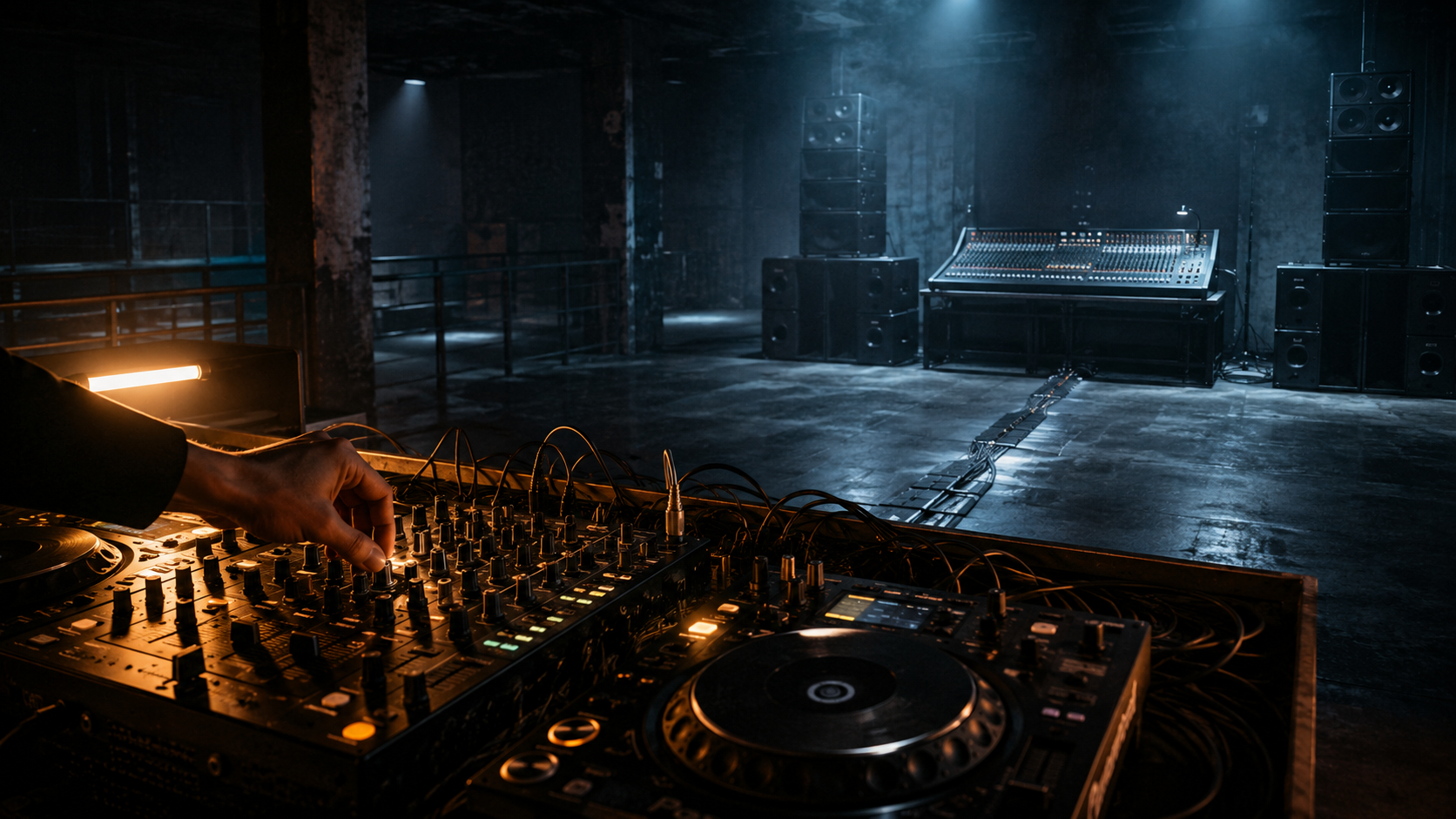
Here's a piece of audio wisdom that turns out to be a piece of life wisdom: the equipment closest to a problem has the most power to fix it. Engineers (both sound engineers and engineers from many other disciplines) call it the nearest-to-the-source principle, and once you understand where it puts the responsibility, a lot of arguments about who's at fault on a bad night just dissolve.
Picture how sound actually moves through a club. It leaves the DJ mixer, runs to the venue's main console, and only from there does it reach the speakers. That's a one-way street. Everything the DJ does has to pass through the house console to get to the room. So if the room sounds bad — say the bass is muddy because the bassbins were never designed right — the question isn't "what should the DJ do about it." The question is which piece of gear sits closest to the problem with the authority to actually correct it. That's the main console. It can rebalance the system without shoving levels so far up or down that it introduces distortion. It's near the source. It has the leverage.
Now flip it. If the house console is the one that's wrong — somebody cut the low EQ too hard — the DJ is upstream of the mistake, and there's nothing they can do to truly fix it. They'll try, because that's human, and what comes out is worse than the original problem. They start distorting the signal coming out of the booth, fighting to compensate for something they were never positioned to compensate for, and the whole performance turns to mud. Not because the DJ is bad. Because you can't properly correct that kind of problem from upstream of it.
Two jobs, one of which never stops moving
The deeper reason these two mixers exist as separate things comes down to what each one is for, and the answer is almost the opposite in each case.
The house console has one job, and it's a stable one: take whatever signal arrives from the stage and translate it faithfully to the PA, with a little sweetening and compression as needed. It's bolted to a specific sound system they're meant to know cold. You can sit down before the night starts, find the settings that get the best possible sound out of those particular speakers in that particular room, and then largely leave them there. A good house engineer makes minor, occasional corrections and otherwise gets out of the way. Once the volume sliders, EQ, and compressors are dialed in, there shouldn't be much left to do unless what's coming off the stage changes dramatically.
The DJ mixer is the opposite animal. It's in constant motion all night — that's the instrument. The DJ is twisting EQ, riding filters, sweeping things, and all that movement is the point. It only reads correctly to the audience because the thing downstream of it is holding still. The static console is what lets the dynamic mixer be expressive. If both were moving at once, chasing each other, you'd never get a stable sound out of the room.
Which is exactly why a maladjusted house console is such a trap. When it's wrong, you're betting the whole night on whatever talent happens to walk through the door being able to fix it live — and that's an unfair bet for two reasons. First, they're not qualified to. The house engineer is the one who's supposed to know that system's quirks; a touring DJ can't possibly know the intricacies of every PA they ever play on. Second, the DJ literally can't hear the problem the way the room does — they're listening through the booth monitor, a different set of speakers than the crowd, so the muddy bass the audience is drowning in might not even reach the booth. You're asking someone to fix a problem they can't fully hear, on a system they don't know, from the one position in the signal chain with the least power to do it.
So the division of labor isn't bureaucracy. It's physics. The DJ's job is to get a great signal to the console. The engineer's job is to know the room and carry that signal the rest of the way. Each owns the part of the chain they're actually positioned to control — and when something goes wrong, the useful question is never "who do we blame," it's "who's standing closest to the problem." That one is worth keeping well past the last record.