What If You Showed EDM to People From the 1950s?
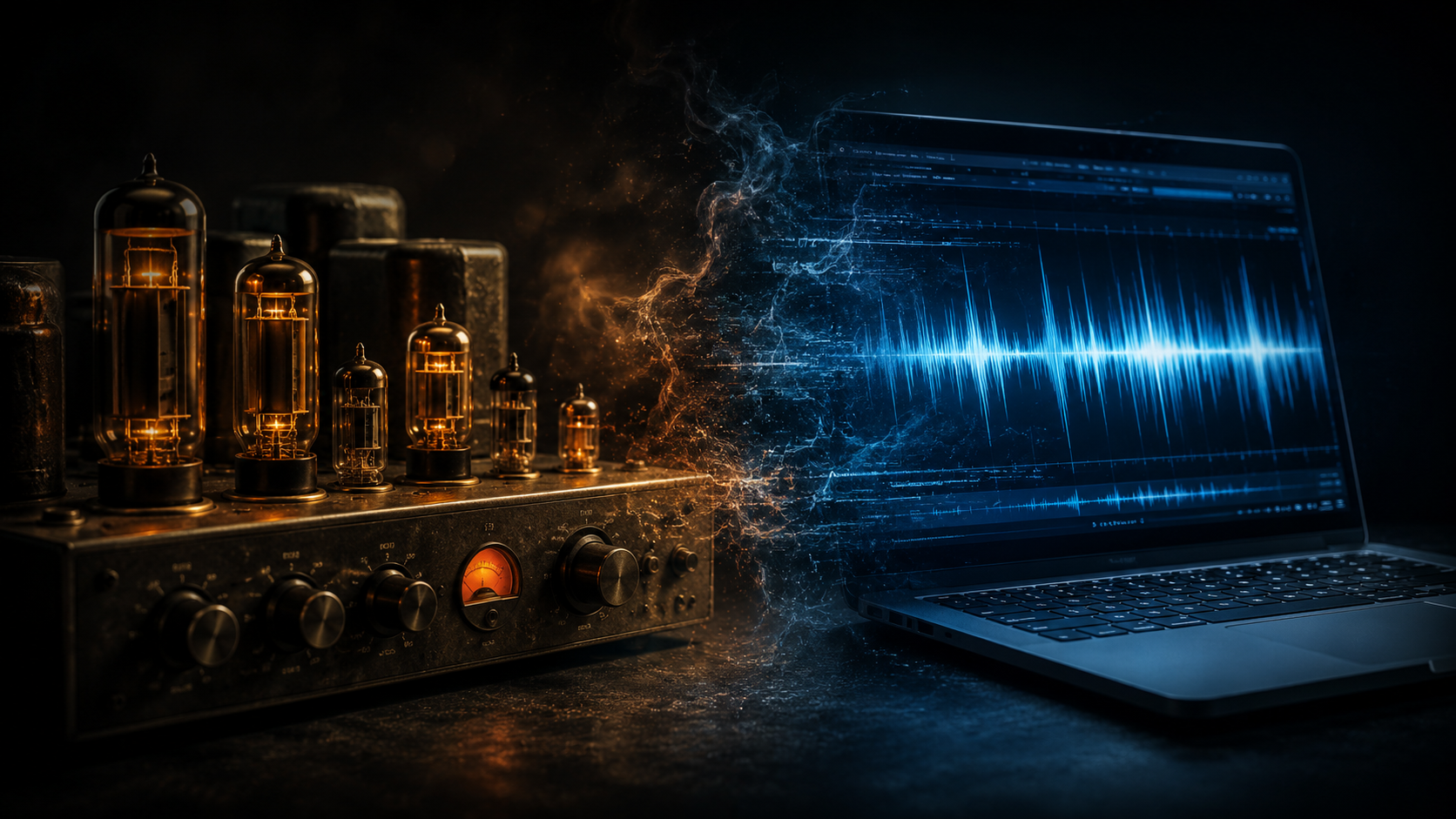
Play someone from 1955 a modern dance track, and the first thing that stops them won't be the rhythm or the volume. It'll be the instruments. They'd have no way to picture how the sounds were made. You'd get a lot of "what kind of horn is that?" and "the drummer's hitting awfully hard," and probably "those drum parts are so simple." The harmony might land. The melody might land. But the actual textures would arrive from nowhere, with no instrument they could imagine behind them.
For almost the entire history of music — from the first humans through the mid-1930s — every sound came from something physical vibrating in person. Strings, drumheads, reeds, columns of air. The full menu of possible timbres was, for practical purposes, known. You might play it brilliantly or badly, but you weren't going to produce a sound nobody had heard the species of before. Then, in the mid-30s, the electric guitar arrived and added a genuinely new color: amplified string vibration. It didn't sound like a nylon or gut-string acoustic. It was new. And by the 1950s, a generation had grown up hearing it in big band, blues, and jazz, so the idea that a new timbre could just join the collective ear had already been swallowed. It wasn't alien anymore.
Then people started doing strange things to that guitar. Chuck Berry and his contemporaries were essentially playing rough blues, but they cranked vacuum-tube amplifiers past the point they were built for, into "unacceptable" levels of distortion, pulling harmonic overtones out of the amp itself. That's not amplified string vibration anymore — that's a new sound, manufactured by abusing the equipment. It was the earliest rock and roll, and for the first time in twenty years, the public was hearing brand-new timbres again. At the risk of flattening a whole decade: the adults hated it, and the teenagers loved it.
So the kids of the 1950s were, in a real sense, already in training for what was coming. They'd been handed the idea that music could keep inventing new sounds, and that the new sounds would feel like an affront to their parents and like the future to them. Show those same kids commercial house or melodic trance — the stuff with vocals, melody, recognizable harmony — and they'd probably find a way in. What would defeat them is the material that sounds least like anything physical. The cold, glassy strangeness of FM synthesis, for instance, which wouldn't even be commercially available for another twenty years. That's the sound with no ancestor they could point to.
And it really is sourceless, in a literal way. Chuck Berry's distorted amp was still a string being struck — abused electronics layered over a physical event you could at least picture. Today's synthesizers, hardware and software both, make sound out of solid-state circuits and math, with nothing vibrating anywhere in the chain until it gets to the speaker. There's no string, no reed, no skin. To an ear trained entirely on physical instruments, that isn't a strange new color on a familiar thing. It's a sound with no body behind it at all, and that's a harder gap to cross than loudness or speed ever was.
And there's a deeper reason it's hard, one that's easy to miss. The whole language of modern dance music is built on the musical history that came after the 1950s. Even the retro corners — funky house, soul house, disco house — lean on funk, soul, and disco, none of which existed yet. So a 1950s listener wouldn't hear disco house as a clever wink at disco. They'd have no disco to hear it against. It would land as one strange new thing, sourceless, which actually makes it harder to accept, not easier. A reference only helps when you understand the thing being referenced.
Here's where I'd land if I had to do it. You couldn't just drop the alien stuff on them and expect anything but rejection. But you could build them up to it. Start near the organic edge — something like electro swing, close enough to instruments they know — and walk them outward, one step stranger at a time, until you're somewhere genuinely far out like brostep. Do it gradually, and you'd almost certainly win over young people and lose the mainstream adult audience, which is exactly what happened with rock and roll and every new sound since.
That's the part worth keeping, even if you never think about synthesizers again: new sounds aren't accepted on their merits; they're accepted on their distance from what people already trust, and on whether you give them a path to walk instead of a cliff to jump off. Every genuinely new thing has to be introduced one tolerable step at a time, and the people who take those steps first are almost always young, almost always told they have bad taste, and almost always right about where things are going.