How to Collaborate
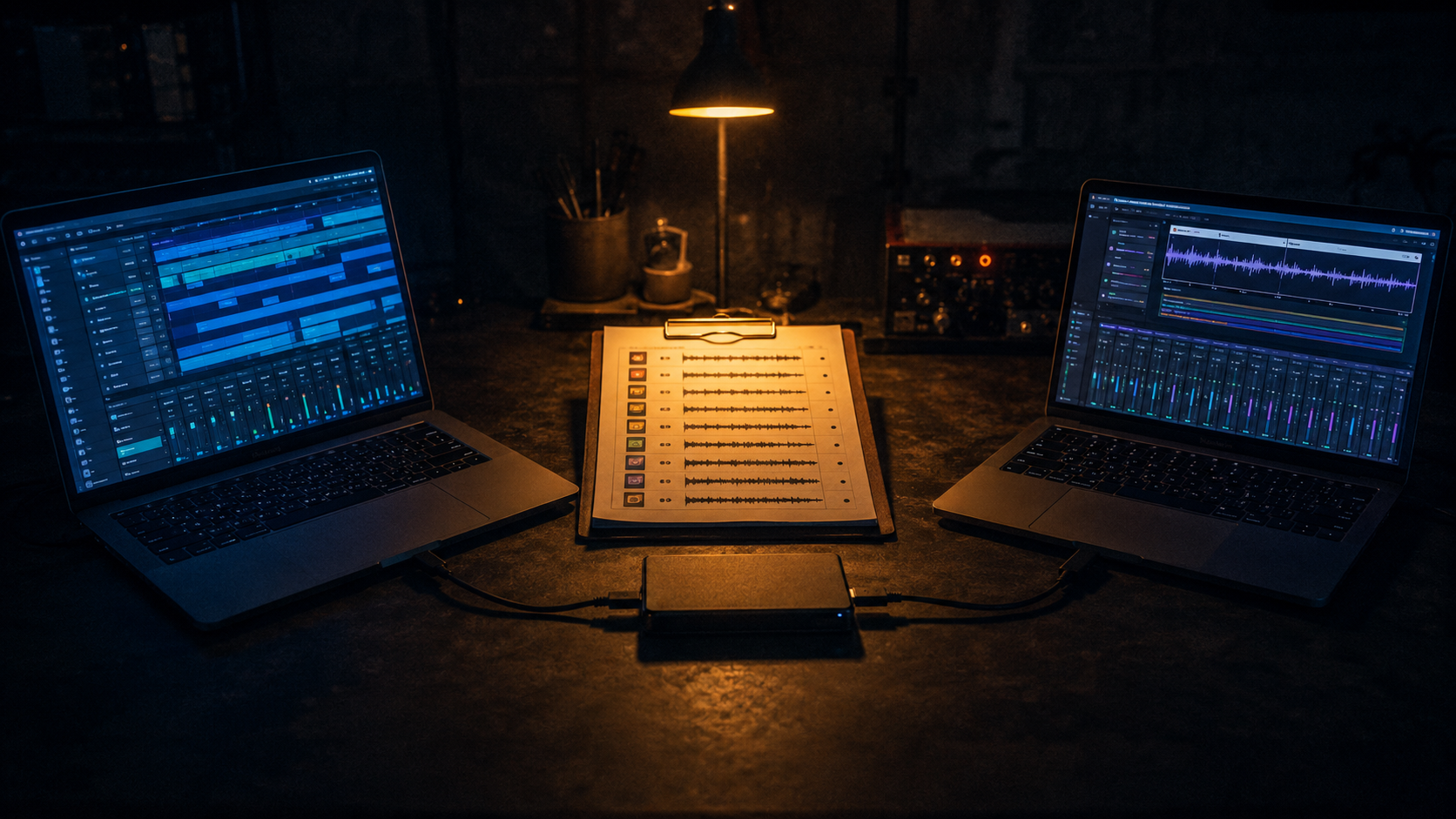
Nothing kills creativity faster than a technical problem, and collaboration is a machine for generating them. The fix my collaborators and I landed on is almost stupidly simple: we never share a project file. We only ever pass audio.
Think about everything that goes wrong the second two people try to work in the same session from different rooms. You're trying to build two identical DAW environments. You're keeping plugins in sync. You're making sure every sample is self-contained, double-checking that the presets exist on both ends. It's a constant headache, and every minute spent on it is a minute stolen from actually making music. So we just don't deal with any of that anymore. We work to the lowest common denominator: audio stems, full stop. No MIDI, no project files.
The workflow is what we call passing the blunt. When we're not in the same studio, one of us works on the track in whatever environment we like, gets it to a point worth handing off, and bounces stems. The other person loads those stems, keeps developing, bounces stems again, and passes it back. That's the whole protocol. Because the only thing crossing between us is rendered audio, it doesn't matter what software, what plugins, what versions either of us is running. The compatibility problem simply stops existing.
What the constraint gives back
What's interesting is that this restriction — supposedly a compromise — turns into a creative engine.
Because we each hold our own copy of the stems, we can split off whenever we want. Plenty of times we'll start a track in one studio, bounce stems at the end of the day, and each take a copy home to develop independently. Then we pass the work back and forth and see what happened. Sometimes the two versions have grown closer together, and we merge them back into one track. Sometimes they've pulled far enough apart that the honest move is to stop pretending they're the same song and just call them two different remixes. And sometimes we wander so far off in opposite directions that we end up with two entirely separate tracks neither of us set out to make — which is its own kind of gift, because that's two finished pieces of music out of one starting idea. Divergent and convergent evolution, both useful, both essentially free, and none of it possible if we were chained to a single shared project file that only one of us could touch at a time.
It does take a little discipline to keep the door open to going back. We increment the version numbers on the project files and name our channels clearly so the stems line up with their sources. The files end up named something like an arbitrary track name, an underscore, a version number — and every channel describes exactly what it is. So when a collaborator asks for the source behind a specific conga-break-with-sidechain stem, I know precisely where to find it. It's not glamorous. It's just enough order to make the freedom safe.
And then there's the benefit that compounds. Work this way, and you'll generate far more audio than ends up in the final track — that's not a bug, that's the point. Stay fast and light, stop worrying about compatibility, keep producing material as audio with every revision, and you'll build a large library of original samples almost as a side effect. After a track's done, I'll dig through every stem we made along the way and file it into my regular sample library, which just keeps growing.
I'm so sold on this that I treat every collaboration as if our DAWs are incompatible, even when they aren't. The discipline it forces — structuring cleanly, naming things, committing to stems — is worth it on its own. And realistically, even when you're working with someone on the same DAW, you probably don't have the same version, the same plugins, all the same everything. Pretend you're incompatible and you'll never get bitten.
The last thing worth saying is that you don't actually need a second person for any of this. I resample heavily, so I'll often run the technique solo — get a track to a point, bounce it, reimport the stems into a fresh project, and keep working, resampling the same audio over and over until it's morphed into something unrecognizable. It's also one of the best ways I know to get unstuck in a mix. Instead of fiddling endlessly with settings, render to stems and reimport; a fresh perspective often shows you exactly why you were stuck. Maybe the fix is the mix; maybe it's swapping a sound; maybe it's new phrasing. Maybe a bit of a few things. The constraint that started as a way to work with people turns out to be one of the best tools for working alone.