Parallel Composition
The advice everyone gives you about finishing music is to focus — pick one track, see it through, then start the next. I do almost the opposite, and it's the single biggest reason I actually finish anything.
There's a piece of production wisdom you'll hear constantly, and it's solid advice: separate sound design, composition, and mixing into distinct phases. I live by it. But I take the separation one step further than most people do, and that extra step is where the whole thing opens up.
Once you've designed a batch of sounds, the natural instinct is to find a great-sounding four or eight bars and immediately start building it out into a full track. I don't. Instead I'll write several great-sounding loops, all side by side in the same project, before I commit to developing any of them. I'm really splitting the composition phase into two parts: generating ideas and developing them. They're different jobs, and they reward different headspaces.
The reason this works is just an accurate accounting of where the effort goes. That initial spark — a loop that sounds exciting — isn't actually the hard part. The hard part is the grind of taking something all the way to done. So I capitalize on the cheap, easy magic while it's flowing and sketch a pile of track-starters at once. I keep them in one "idea generator" project, same key, same family of instruments, so they hang together — which is exactly what you want if they're destined for the same set, the same EP, the same release.
There's a reason I won't let myself jump straight from a hot loop into building a finished track, and it's about protecting the right kind of thinking. Generating ideas and developing them are genuinely different jobs. Idea generation wants you loose, fast, a little reckless — you're fishing, and the worst thing you can do is fall in love with the first thing you catch and stop fishing. Development wants the opposite: patience, commitment, the willingness to sit with one thing until it's finished. If you let those two collapse into one move, what usually happens is you commit to the first decent loop simply because it's in front of you, and three better ones that you'd have caught in the next twenty minutes never get written. So I keep generation as its own phase on purpose, and I don't start choosing until I've got a spread to choose from.
Move them down the pipeline together
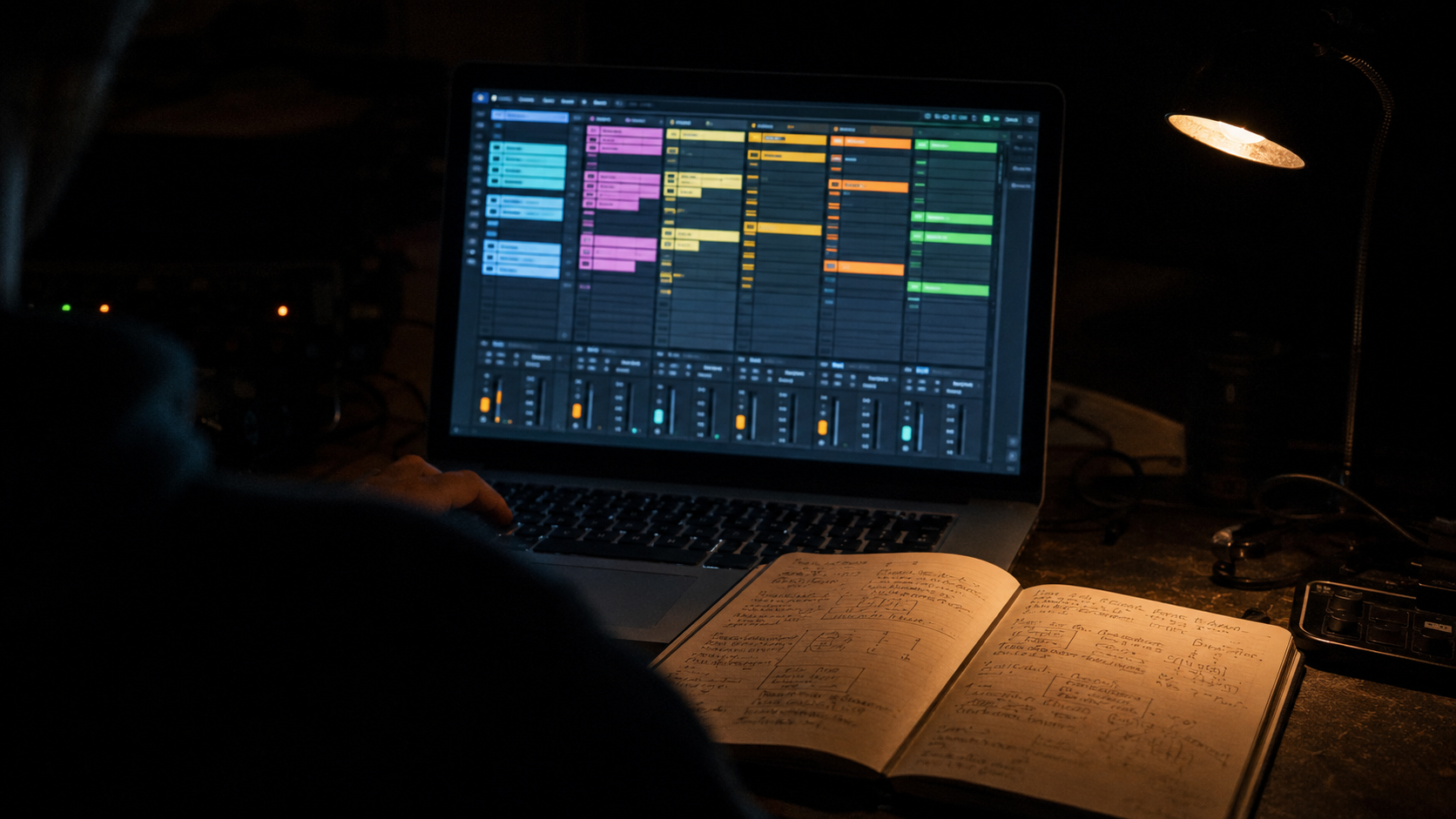
Then I pick the ones I actually like and promote them to the development phase — and I develop them in parallel. Each one gets a rough structure blocked out: intro, buildup, main section, breakdown, second drop, outro. Light and loose, no nerding out on detail yet. Working in Session View makes it easy to get several tracks to this stage inside a single project file, all moving down the pipeline side by side.
I audit them as they go. The ones still showing promise get promoted again, this time to their own project files, and that's where the real heavy work starts — the details, the variations, the character that makes each one its own thing. This is the slow, expensive part, and here's the quiet payoff of doing it in parallel: when I hit a wall on one track, I don't sit there staring at a four-bar loop willing it to tell me what comes next. I switch to another one. Changing gears keeps me moving, and more often than not, it shakes loose whatever had me stuck on the first.
When the composition's done across the batch, I break everything back into stems and mix the whole group together in one project, so they're all referenced against each other and stay harmonious — they were always meant to live in the same room. The leftover audio from all of it, every stem and revision that didn't make the final cut, gets folded back into my sample library.
And that's the part that compounds. I'm never building one thing in isolation. I'm completing more work across more tracks at every stage, letting progress on one inspire another, and continuously growing the library the whole time. So the next time I sit down to start a batch from scratch — the next EP, the next set of tunes — I'm not starting from zero. I'm building on everything that came before, including the stuff that didn't make it. The unfinished ideas aren't waste. They're the seed material for the next round.
That's the real point. I don't write a track start to finish and then move to the next one. I move small chunks of many tracks forward at once, and the work feeds itself.