Structure vs. Free Composition
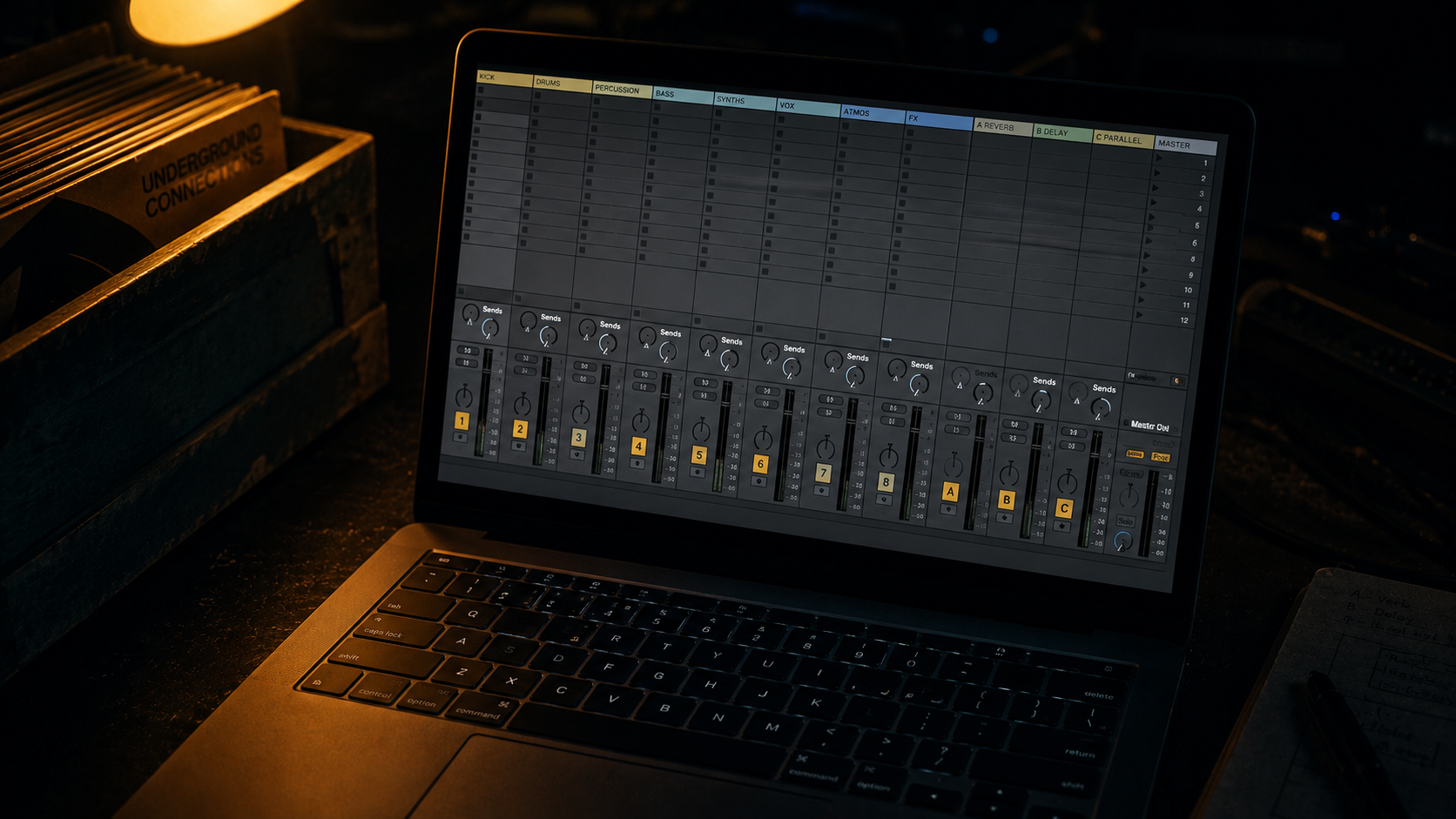
I'll let you in on a secret nobody tells you when you're new: the most creative records you'll ever make won't come from having every sound in the world at your fingertips. They'll come from boxing yourself in.
I've spent the better part of twenty-five years swinging between two ways of working. One is rigid and templated — open the project, the drum kit's already loaded, the routing's already done, you just start. The other is wide open — blank session, no assumptions, you find the track by stumbling into it. I've lived at both ends, and most of the spots in between, and the thing I keep coming back to is that those two aren't enemies. They're phases of the same cycle. Knowing which one you're in is most of the job.
You can't template what you haven't done
A structured workflow doesn't fall out of the sky. You can't build a repeatable pattern for making something until you've actually made that something — usually over and over. The freeform, fumbling, where-is-this-even-going phase isn't the amateur version of production you graduate out of. It's the part that earns you the right to a template. You go through it open and messy first, and only then can you look back and see what you actually did.
When you're ready to optimize, there are two ways in. The loose one is to watch your own habits. Do you always split the kick drum into its own channel and mix it separately? Do you stack a low-passed sub under a high-passed midrange bass every time? Do you reach for the same reverb, the same sidechain move, without thinking? Those reflexes are a template trying to be born. Pre-build the starter channels for the things you always do, and you stop re-solving solved problems.
The tighter way is more surgical. You make a track you're genuinely proud of — the kind where you think, I want a whole album of this — and instead of chasing the feeling blind, you take the project apart. Look at what it contains, how it's routed, how it's structured. Separate the architecture from the content so you can see the skeleton the sounds were sitting on. Then build a clean template that mirrors that skeleton, and a sound library stocked from the original: rendered audio, which is really you building your own sample pack, plus the synth patches, the effects chains, and the homemade presets. Now you've got the bones and the material to fill them. Productivity goes through the roof, because every decision you already made is waiting for you the next time you sit down.
Both of those paths lean on the same two pillars: organization and templates. The whole point is that you're not rebuilding the same scaffolding every single time. You don't want to assemble your drum kit from scratch on every track — you want a go-to kit already loaded that you drop in and start banging on. Push it a step further and have the MIDI patterns sitting right there next to it, the grooves you reach for again and again already programmed, and you're deep into the territory where the mechanical part of production just disappears, and you're left with the part that's actually music. That's the real prize structure buys you: the clearing-away of everything that isn't the creative decision, so that when you sit down, the only thing left to do is the thing you came to do.
Why the box is where the creativity lives
Say all of that out loud — patterns, repetition, templates — and it sounds like the death of creativity. Most people assume the open, anything-goes session is the creative one and the templated session is the assembly line. That's backwards.
Real creativity doesn't come from infinite choice. It comes from constraint. When any sound on earth is one click away, finishing anything becomes agony, because every decision stays open forever. But hand yourself a tight twenty-megabyte sample pack you built and know inside out, work only inside that limitation, and watch what comes out of you. The pioneers of this music were working with almost nothing — a handful of machines, a few hundred kilobytes of sample memory — and listen to what they built. The limits weren't the obstacle. The limits were the engine.
That's what structure is really for: consistency and quantity. If you want to produce a real body of work in a real timeframe — an EP, an album, a year of releases rather than a year of half-finished projects — you need a repeatable pattern to pour the effort into. And structure clears the questions that derail you mid-flow, the little ones that don't feel like much until you've answered the same one for the hundredth time: where's that sound in my library, what do I add next, why does this take twenty minutes to set up every time? Structure doesn't pretend you never ask those questions. It just makes sure they've already been asked and answered before the session even starts, so the energy goes into making music instead of connecting plumbing.
And then the box becomes a cage
But the same thing that makes a template powerful is the thing that'll eventually strangle you.
Be honest about the numbers. How much of what you make in the studio is actually good enough to put out? Ten percent? Five? Anything that raises your output raises your odds of landing something worth releasing — that's the whole case for working fast inside a system. The flip side is that the system can't take you anywhere it wasn't already pointed. That's by design: give yourself a limitation, work the limitation, generate material. But push it long enough, and you'll cross a line. You stop inventing. You're just repeating yourself — running the same formula until it's worn smooth, making competent records that all sound like the last one.
There's only one way out, and it's not subtle. You leave the template behind and start over from scratch. Throw out the assumptions, go back to the experimental, free-flowing way you worked when you were new and didn't know any better. And the move that breaks it has to be fundamental — not a new preset, something at the floor of your process. Always sequence your drums from MIDI? Stop. Drop audio straight into the channel instead, or work from breaks and loops instead of clean one-shots. Change something so low in your stack that everything above it has to be rebuilt.
Break the template on purpose, and you'll find ideas the optimized version could never have reached. New "a-ha" moments, things you actually want to chase. And then it starts looping back on itself: chase those ideas long enough, and you'll start noticing your new habits, your new reflexes, the new things you keep doing because they keep working — the beginnings of the next template, forming whether you mean them to or not. So you refine it, you master it, you optimize for output again, and then one day you'll feel the walls closing in, and you'll tear the whole thing down and start over. That's not failure. That's the shape of the work.
When people ask me how my workflow changes from song to song, that's my answer. In fact, I wrote this post to make that question easier to answer. Some days I'm deep in a system, banging out variations on a sound I know cold. Other days, I've deliberately blown the system up, and I'm lost on purpose, looking for the thing I couldn't have planned for. Neither one is the right way. Knowing which phase the work needs — that's the right way.