The Tool Was Never the Problem
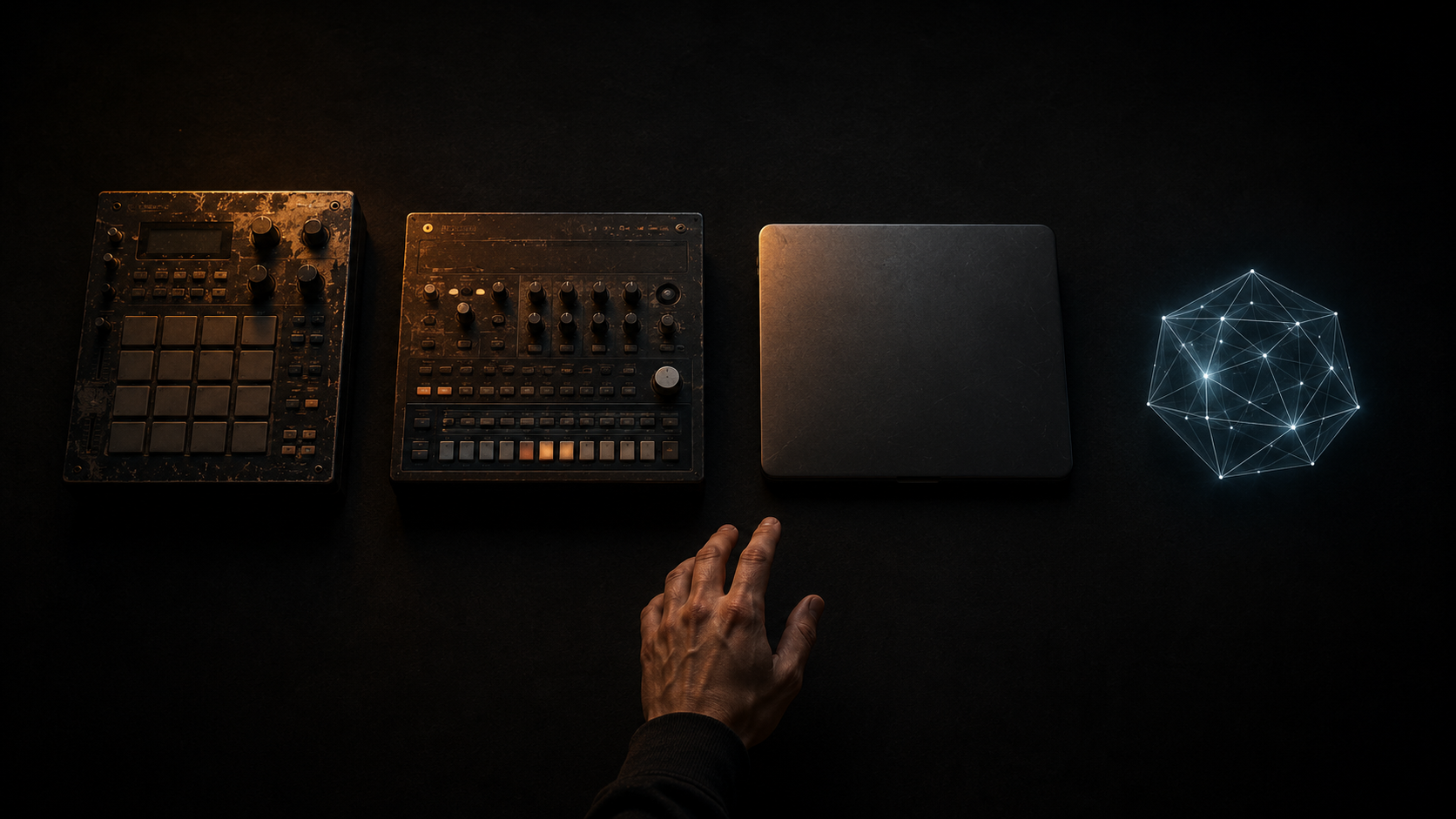
I got into it in a comment section last week. Someone posted that anyone using AI in their music is a fraud, full stop, and I said it wasn't that simple, because it isn't. I use AI to sketch ideas — to throw a rough shape on the wall fast, so I can hear whether an arrangement is worth chasing before I give up a whole night building it for real — and that, to me, is a tool, the same as everything else on my desk. What I won't do is let a model write the track and then sign my name underneath it. That isn't a tool anymore. That's a ghost-writer, and pretending otherwise is the actual fraud.
The thread did what threads do — it generated a lot of heat and not much light. But underneath that noise there was a real question, and it deserves a slower answer than a reply box can hold, on a page I actually own.
We have had this fight before
Every piece of technology that ever mattered in this music arrived as an insult to the one before it. "The sampler is theft," because you hadn't played anything, you'd stolen it. "The drum machine is the death of the drummer", a cold box for people who couldn't keep time. "The DAW meant you weren't a real producer anymore," just somebody clicking a mouse, and "the software synth was going to flatten every record down to the same handful of presets." Each time, a generation that had honed its skill on the last set of tools looked at the new one and saw the end of their craft.
And each time, the panic was wrong in exactly the same way. Hip-hop didn't die from the sampler; it was born out of it. Acid house came out of a machine Roland built for something else entirely and discontinued because nobody wanted it, and breakbeat, jungle, and the whole hardcore continuum are all just people bending cheap, supposedly illegitimate gear toward a purpose its makers never imagined. The tool never replaced the artistry. The artistry defined how the tool found its enduring purpose.
So when somebody tells me AI is the line this time, the final straw, the thing that finally kills real music, well, I've heard that song before, and I know how it ends. The technology stays. The culture absorbs it. Good artists find something to do with it that nobody saw coming.
But the panic was always pointing at the wrong thing
Thirty years of having this argument taught me that the fight is never actually about the tool. It's about whether a human is still the one making decisions. A sampler doesn't choose the loop, a drum machine doesn't write the pattern, and the DAW doesn't decide where the drop lands or why the breakdown holds four bars too long on purpose. Every one of those tools is an extension of a person who is doing the only thing that was ever scarce — deciding, choosing this and not that, and knowing when it's right.
That's the line. And it's the reason AI doesn't get a free pass just for being the next box in the lineage. Sure, AI is the first tool that could make the decisions for you. You can ask it for a track, and it will hand you back a finished thought — the structure, the sound design, the whole lot — except the choosing, the part that was always the real work. That never happened, because you skipped it. Sign that as yours and the tool hasn't extended you. It replaced. And you let it.
It isn't a hard distinction to hold. Use the machine to reach your own decisions faster, and you're using a tool. Let the machine make the decisions and launder them through your name, and the tool's using you. One amplifies an artist. The other deletes the artist and keeps the credit.
Amplification only works in one direction
I build AI systems for a living when I'm not making music, so I've thought about this more than I consider healthy. So I know where I landed on this debate. The right way around is simple enough: you have something to say, and the tools help you say more of it, more clearly, to more people. The grunt work compresses — reference-gathering, rough sketching, production prototyping, the administrative side of actually finishing a record — so the hours you claw back go straight into the part that genuinely needs you.
That all inverts the moment you start making the music the machine is best at amplifying, when the tool's appetite for volume, for content, for whatever the algorithm happens to reward today quietly starts shaping what you make instead of the other way around. That's a trap, and it has nothing to do with AI specifically. It's the same trap as chasing a sound because it's charting, and the only thing the technology changes is how fast and how cheaply you can disappear into it. Amplification is supposed to serve the expression. The day expression starts serving amplification for its own sake, you've lost the plot, and no amount of reach will buy it back.
Competence was never the point
People keep asking whether AI can make a decent track. You can tell that's the wrong question because the answer is so boring: of course it can. Competent, listenable, technically correct music is precisely the thing an AI system is built to produce; it's heard everything, and it'll hand you a serviceable version of whatever you ask it for. But competence was never the scarce resource. Clubs are not exactly short on "competent" tracks. What they're short on is records that do something slightly wrong on purpose and turns out to be magic, when an artist walks in with a sound that shouldn't work and rewires the ears of everyone in the room because of it.
The question I care about isn't whether AI can make a track. It's whether software can produce the next artist who changes how we think about music. I don't believe it can, because that has never once come from competence. It comes from a specific person, in a particular place, at just the right moment, with something to prove, and a body on the floor that needs moving. Transformation doesn't come from averaging everything that's already been done. It comes from someone refusing to conform to average.
What stays mine
There's a part of this work where the human isn't a bottleneck to optimize away. The human is the point. Taste, voice, the decision about what's worth making and what to throw out. Having the nerve to put something physical and a little uncomfortable into a room and stand behind it. That's not friction to be removed. And whatever that thing it is that makes a record sound like a person was in the room when it was crafted instead of a server farm, the audience can feel it, even when they can't tell you what that feeling is. As our feeds fill up with frictionless, competent, authorless sound, that feeling gets easier to read, not harder, and the genuine article gets more valuable, not less.
I'm not worried about the machine. Never have been. I lived through the sampler being the end of music, and the drum machine being the end of music, and the laptop being the end of music, and here we all still are. The tool was never the problem. The only thing that was ever really in danger is the part of the creative process where a person makes the decisions — and that part isn't going anywhere, unless we choose to hand it over and call it progress.
I'm keeping mine.
— Dyson Hope