The Underground Didn't Die, It Accelerated (II)
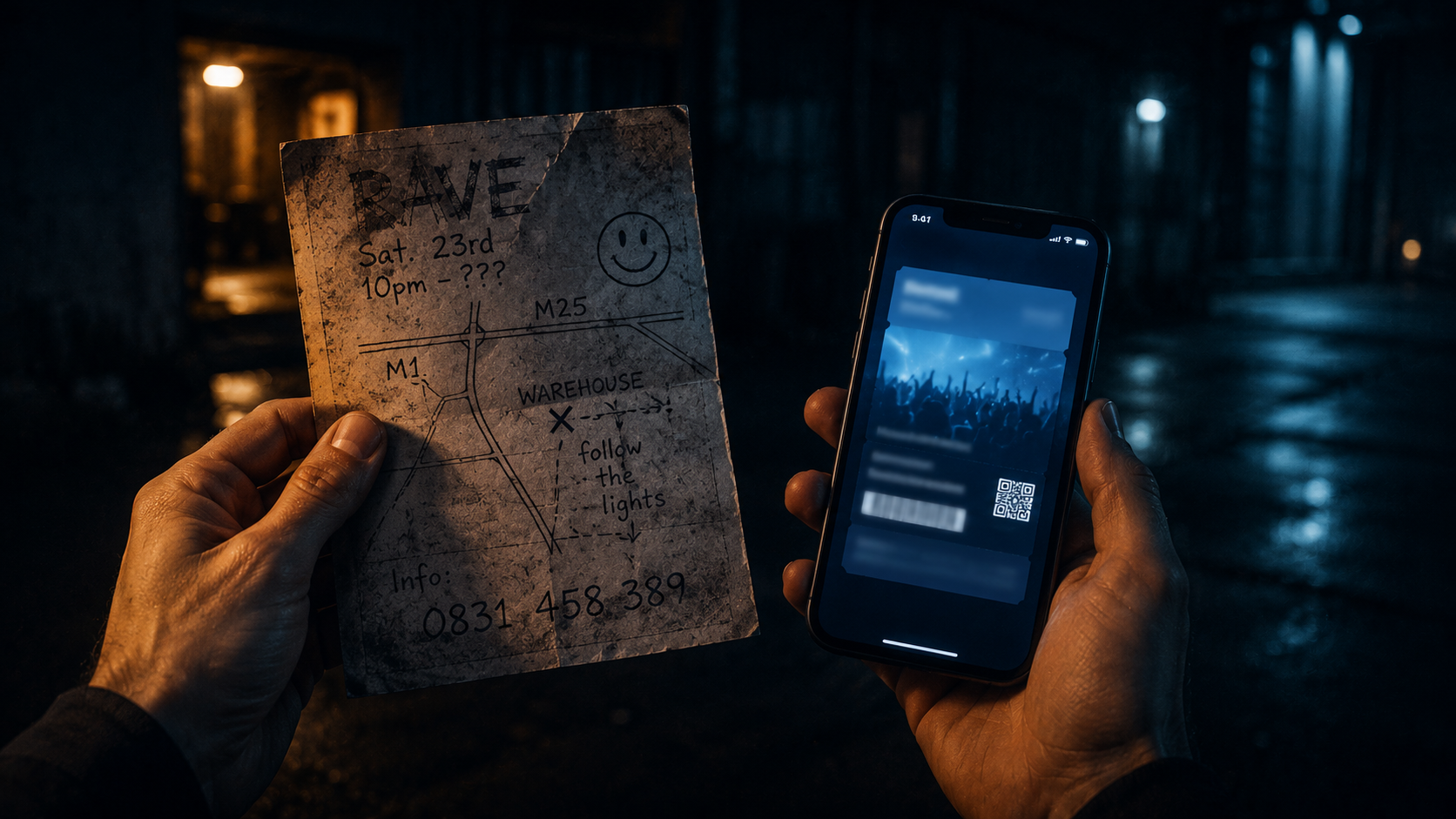
When people my age say the underground died, what they usually mean is that it moved and they didn't move with it. I understand the feeling completely, and I think it's wrong. Or rather, the part that died was never only the music. It was a particular experience of being in on a secret, and that experience didn't end. It relocated, and a lot of people stayed standing where it used to be.
I started raving thirty years ago, which is a sentence that makes me feel ancient to type. The scene then was genuinely underground. Nobody had heard of it. We felt like a secret society, breaking into warehouses and setting up speakers in the middle of the night. It was raw and edgy, and it felt like the future. We didn't order our rave gear off a website — there were no websites — we made it by hand. The whole thing was do-it-yourself, by and for the people who showed up. The first time I went to Raver Day at Disneyland, strangers seeing us in our phat pants and strange accessories asked if we were "some kind of group." Disneyland's staff couldn't stand us because guests kept mistaking us for an attraction. I was at the first Electric Daisy Carnival. Now, with its twenty-fifth anniversary coming up, people I know who have never been to a rave in their lives ask me if I'm going.
That's the change in one image. The thing that was a secret became a brand.
It got commercialized. That's the short version. The underground local events never stopped — they're all over the world right now — but once big business decided dance fans were an untapped market, the raves that broke through stopped being secretive affairs with photocopied flyers and map points to unpermitted venues. They got big and slick and sponsored by beer companies. And that reshaped the music a little, because suddenly pop and hip-hop artists wanted to work with dance producers, and the line between underground and mainstream blurred. But the deeper change was to the culture, and it's the same reorientation I keep coming back to: at a 90s rave, the DJ wasn't the center of anything. The energy pointed inward at the dancefloor. The magic was something the ravers made themselves. At most big commercial events now, the energy points forward, at a superstar up on a riser pressing play and doing the Jesus pose. The crowd went from generating the night to receiving it.
So I understand why a lot of the people I came up with quit. Most of them don't rave anymore. But notice what they actually quit: they didn't stop because they got old or busy in the ordinary way people drift from their hobbies. A real chunk of my generation quit because raving stopped being underground — because the specific thing they loved, the secrecy and the inward-facing DIY of it, got paved over by the commercial version. That's a different reason than "I lost interest." They didn't lose interest. The thing they were interested in moved, and they decided the new room wasn't theirs.
The irony that gets me is that the people twenty years ago who were hauling speaker stacks into the desert to dance to techno for twelve hours straight are often the ones who can't see the thriving underground happening right under their noses today. Yes, house music is enormous now, and you can walk into any 21-and-up club in a major city and watch a fairly basic crowd grind it out. That doesn't mean the underground died. It means the underground moved, and they didn't keep up. The ones from my generation who are still in it for the music, who keep their ears to the floor, can still find the new edge — the quasi-legal event with the cutting-edge sound where I'm usually the token old guy, and exactly where I want to be. It takes real effort to keep up with the underground. That effort is the price of admission, and always was.
That's worth dwelling on, because it's where most of the "it died" talk actually comes from. The underground was never free to belong to. When it was warehouses and pirate radio, you had to know someone, drive somewhere sketchy, and stay curious enough to keep finding the next thing before anyone wrote it down. The cost was never money; it was attention and willingness. What happened to a lot of people isn't that the scene betrayed them — it's that, somewhere along the way, they stopped paying that kind of attention. Life gets full. The drive across town starts to feel long. And the moment you stop chasing the edge, the edge moves on without you, and from where you stand, it genuinely looks like it vanished. It didn't. You just stopped meeting it where it went.
You can see the same shape if you zoom out across whole countries. Europe took commercial dance music to heart a full generation before America did — it's been on every pop station and over the speakers in every café and corner bar from London to Sofia for decades. The US arrived there much later, now hearing dance music not on dedicated stations but folded into the regular Top 40 rotation, which is why the average American knows "EDM" as two or three festival anthems and not much else. But that ubiquity didn't kill anything in Europe. It matured the audience, and underneath the commercial surface, the European underground kept turning over, country by country, into whatever was next. Mass acceptance on top, restless invention underneath. The two coexist. They always have.
You can almost hear the difference standing in two different clubs. Anything you hear in a major Las Vegas nightclub is going to be commercial — and the same is true for a lot of clubs in Ibiza, too. That part's the same. What's different is the breadth of the menu. In Vegas, you get a narrow slice — the handful of anthems the radio decided on. In Ibiza, you get a far broader spread of commercial dance music because the audience has been steeped in it long enough to want that range. That's what a mature listening culture buys you — not the disappearance of the mainstream, but a deeper, more varied one, with the genuine underground still humming along underneath it the way it does everywhere. The surface gets richer. The edge keeps moving. Neither one cancels the other.
And this is the part I'd want anyone to hold onto, especially anyone who's ever felt a scene they loved get popular and curdle. In a generation, this all happens again. The kids, deep in whatever's underground right now, will watch their favorite sounds either bubble up to the mainstream or fade out; a new underground will form behind them, and they'll be the ones grumbling that the magic is gone and the kids today don't get it. The magic won't be gone. It'll have moved (the way it always does) to a room they're no longer in. The underground doesn't die. It relocates, and it asks you to keep walking if you want to stay with it. Most people stop walking, and then they tell you it's dead. It isn't. They just stopped following it.