Zero Tolerance on Stage: Performance Rig Reliability
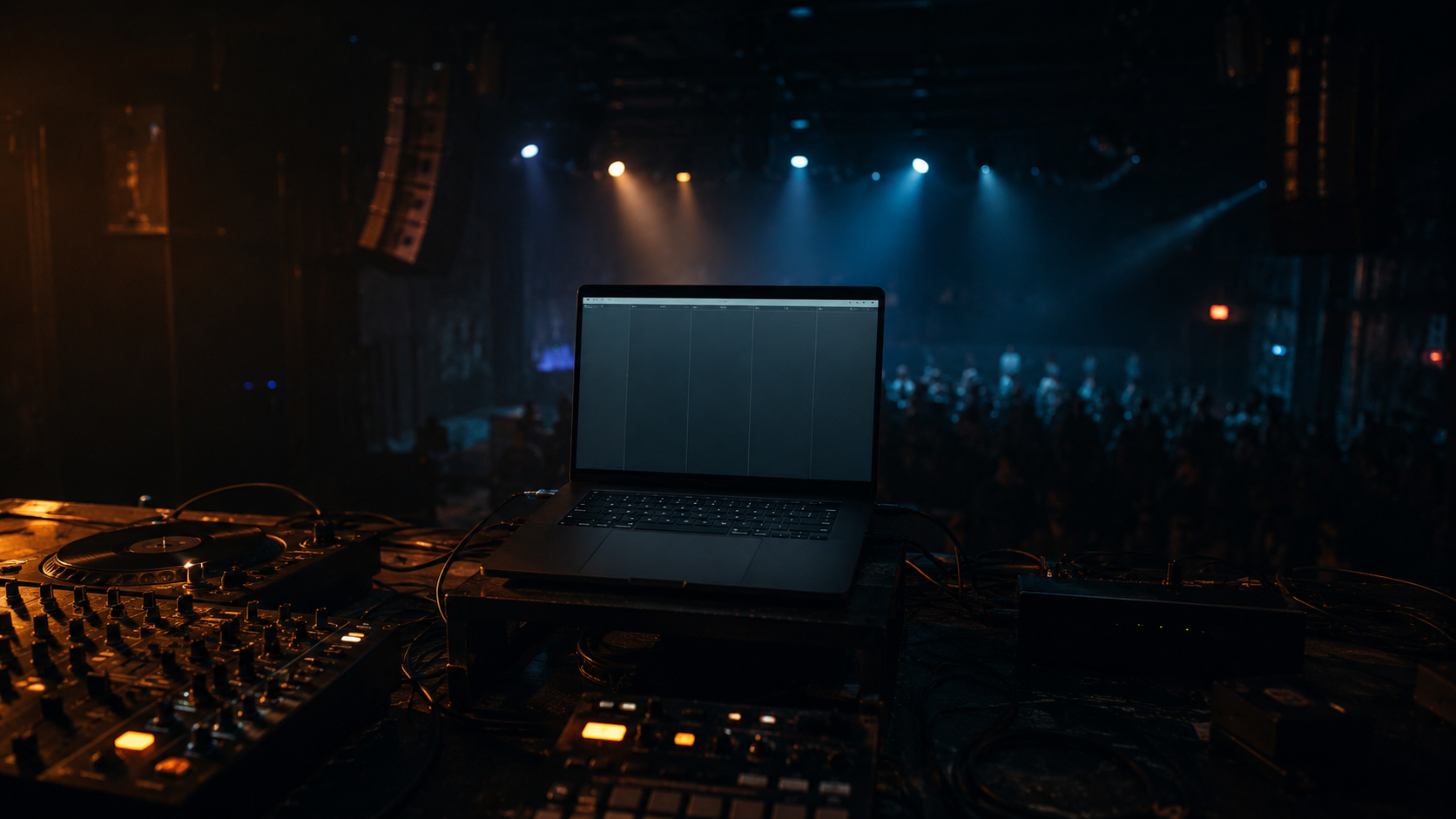
There's a standard I hold in the studio, and a different one I hold on stage, and the gap between them is the whole job. In the studio, I have very little tolerance for gear that crashes. On stage, I have zero. Not "low." Zero. If a piece of hardware or software hasn't proven to me that it never crashes, it doesn't come out under the lights — and that one rule has done more for my performances than any controller I've ever wanted to buy.
I've been playing live with the same software since 2010, and in all that time, I've never had a technical failure on stage that was the software's fault. I want to be careful with that sentence, because it sounds like luck, and it isn't. The one time something did go wrong, it was a borrowed machine — mine got stolen right before a gig, so I installed everything fresh on a loaner and copied my session over, and let's just say that particular laptop was not built for MIDI reliability. That night is the exception that proves the rule. Stability on stage isn't something that happens to you. It's something you build, at home, in advance, by being paranoid about it long before anyone's watching.
So I've collected an uncountable number of headaches in prep, setup, and rig configuration, and I've collected them on purpose. I would much rather discover every kink in my home DJ booth than in front of a crowd. That's the trade. You move all the pain forward to a place where a crash costs you nothing but patience, so that none of it is left to surprise you in the place where a crash costs you reputation.
Keep the machine clean
For most performances, I use a dedicated machine with nothing on it — and I mean absolutely nothing — that I don't need to perform. Every operating-system convenience that quietly eats resources without contributing to the show gets turned off: Bluetooth, file system indexing, the graphical prettifiers, all of it. Wi-Fi, too, for years, until I started running MIDI over Wi-Fi and had a reason to bring it back. None of it even starts up at boot. The machine isn't a computer that also happens to perform. It's a performance instrument that happens to be a computer.
If you can't dedicate a whole machine to it, the next best thing is a separate bootable partition kept as minimal as possible — your normal life on one side, your stage rig on the other, and you boot into the clean one when it's time to play. The principle underlying both options is the same: the fewer moving parts there are, the fewer that can fail. Every process you're not running is a process that can't crash on you mid-set.
Earn your way onto the stage
I'm ruthless about what hardware and software I'll bring out live, and the bar is as brutal as it is simple: if it isn't totally, completely, never-crashed-once stable, it doesn't play. There's always some shiny new controller I'm drooling over — there always is — but wanting it isn't the same as trusting it. Until I've put it through its paces and confirmed it's genuinely rock-solid, it stays home. Desire doesn't get a vote. Reliability does.
The same ruthlessness goes for whether you run live synths or rendered audio. Audio almost never crashes; software synths do. I understand the allure of live softsynths — the flexibility is real, and there are whole legendary setups built entirely around them, no audio at all, everything generated live on stage — but that flexibility costs you an enormous amount of quality-assurance work to make safe. You can absolutely have it. You just have to earn it, every component, by proving it won't fall over.
Break it on purpose, at home
Here's the part most people skip, and it's the part that actually separates a setup that works in the studio from one that survives a gig: deliberately abuse your rig before the night, in all the ugly ways the night might abuse it.
In the studio, it's easy to build the ideal configuration and jam. But on stage, nothing is ideal. So I test the failure modes directly. Pull the power adapter and let the machine drop into low-battery mode to see whether power management does something stupid. Yank a USB peripheral out mid-session and plug it back in to confirm it comes back cleanly. Put the computer to sleep and wake it to find out whether you can keep playing, or have to relaunch the software, or — worst case — have to power-cycle the whole machine while a room full of people waits. You want to discover every one of those answers in your living room, where the answer is just information, not in front of a crowd, where it's a disaster.
Find every gotcha. Then figure out how to avoid each one, and practice the setup until avoiding is muscle memory. Do that, and you walk on stage with something that works the first time, the last time, and every time in between — not because you got lucky, but because you used up all your bad luck at home, on purpose, where it was free.
That's the whole philosophy, and it long outlives any specific laptop or piece of software in it. The gear in my rig has changed and will change again. The standard hasn't moved an inch. Zero tolerance on stage isn't about being precious. It's about respecting the moment enough to do all the suffering beforehand, so that when the lights come up, the only thing left to think about is the music.